
A Fascist Haunting: Trump and the Enduring Relevance of the Twilight Zone’s “He’s Alive”
In a 1963 episode written by Rod Serling and starring Dennis Hopper, the ghost of Hitler returns to haunt America.


Bram E. Gieben published The Darkest Timeline with Revol Press in 2024. He hosts the philosophical podcast Strange Exiles, where he is currently publishing the ongoing essay series Crisis Masculinity, exploring male identity under late-stage capitalism. His next book for Revol is anticipated in 2027.
In the 1963 episode of The Twilight Zone, “He’s Alive”, a young Dennis Hopper plays Peter Vollmer, an aspiring political rabble-rouser and leader of a uniformed gang of proto-fascist thugs. Both a direct allegory for the conditions that led to the rise of the Nazi party in Germany and a chilling ghost story in its own right, the episode now offers some disturbing parallels with the incipient fascism of Trump’s America, and its slide towards authoritarianism and racial purity politics. Written by Twilight Zone creator Rod Serling, a World War Two combat veteran, the episode’s condemnation of Vollmer and his politics is both unambiguous, and undeniably relevant. However, its conclusion also seems optimistic when viewed through the prism of Trump’s distinctly modern fascist politics. Vollmer’s eventual death and defeat leans on tropes of American decency and humanism, both qualities that seem to be in short supply among Trump’s supporters.
The episode begins with Vollmer’s gang preaching their doctrine of racial hatred in the streets of a small town. A gathered crowd listens until one man offers resistance, and beats Vollmer bloody in front of his goons. Dispirited, Vollmer retreats to the apartment of his childhood friend and mentor Ernst Ganz, an elderly Jewish man who we later learn is a Holocaust survivor. Ganz recalls Vollmer’s childhood as the son of a drunken, abusive father and a mentally ill mother, reminding Vollmer that he was a scared and damaged child “... crying in my doorway at night.” Despite Ganz’s disgust with Vollmer’s politics, the two have remained friends over the years. Vollmer defends his ideology, arguing: “It’s not hate, it’s a point of view, it’s a philosophy.” He rebukes Ganz for his humanism, and characterises even the sympathy he showed the young Vollmer as weak. Ganz does not contradict him, agreeing that his flaw is “...softness. The weakness that makes a man his brother’s keeper… this is my sickness. I only see the boy, not the man.”
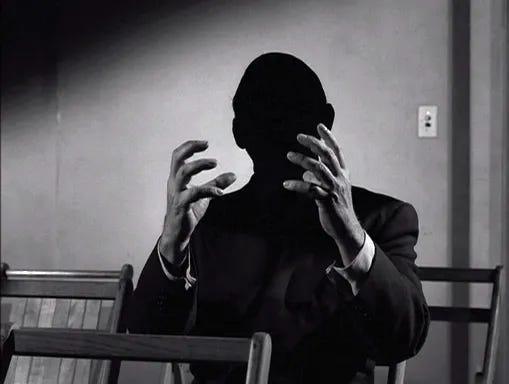
Vollmer sleeps on Ganz’s couch, but is awoken by the sound of a voice calling his name from the street. The man’s face is shot in perpetual shadow. He offers Vollmer advice on how to increase his appeal to the masses: “Let us start by your learning what are the dynamics of a crowd. How do you move a mob, Mr. Vollmer? How do you excite them? How do you make them feel as one with you? Join them first, Mr. Vollmer. When you speak to them, speak to them as if you were a member of the mob.”
The shadowy figure speaks with a clipped German accent, foreshadowing the reveal that this is a visitation from the ghost of Adolf Hitler. Here, the parallels with Trump’s approach to whipping up the American public begin to become clear. What the figure advises Vollmer to do at his small-town rallies is, blow-for-blow, the Trump playbook: “Speak to them in their language, on their level. Make their hate your hate. If they are poor, talk to them of poverty. If they are afraid, talk to them of their fears. And if they are angry, Mr. Vollmer, if they are angry, give them objects for their anger. But most of all, the thing that is most of the essence, Mr. Vollmer, is that you make this mob an extension of yourself.”
Vollmer asks the figure how he found him. “I simply followed your ideas, Mr Vollmer,” he replies. Serling’s script hints that this is a different kind of ghost story. Far from being a mere ghost of the Nazi Führer, this shadow-faced figure is his geist of Nazism – an expression not just of Hitler the man, but of Nazis as a group, and an ideology. Hitler’s geist (or spirit) has found a new avenue for expression in Vollmer’s rhetoric, and like a moth to a flame, is drawn to him across time, death, and existence itself. Serling’s allegory aims to show that the ideology of fascism is not dependent on historical, materialist conditions – rather it is a shadow of human nature, always ready to be brought into being by damaged, angry young men.
Serling’s opening monologue describes Vollmer as “...a sparse little man who feeds off his self-delusions and finds himself perpetually hungry for want of greatness in his diet,” a description that fits very well with the egomaniacal Trump persona. Like Vollmer, Trump too is the product of a brutal father figure. Frederick Trump was an angry, domineering presence, as detailed in Mary Trump’s book Too Much and Never Enough: How My Family Created the World’s Most Dangerous Man. “By limiting Donald’s access to his own feelings and rendering many of them unacceptable, Fred perverted his son’s perception of the world and damaged his ability to live in it… Softness was unthinkable”, she writes in an excerpt quoted by the BBC in 2020. The result is a man who craves not just greatness and approval, but also self-justification. As Serling says of Vollmer in the opening monologue, Trump also “... searches for something to explain his hunger, and to rationalize why a world passes him by without saluting. That something he looks for and finds is in a sewer. In his own twisted and distorted lexicon he calls it faith, strength, truth.” Like Vollmer, Trump’s revenge against the world, and his father, is dressed up as virtue.
Following the shadow-figure’s advice, Vollmer quickly learns how to whip a crowd up into a frenzy. The audience of his town hall meetings grows, much as the audiences of Trump’s rallies ballooned in the run-up to the 2024 elections. Vollmer’s association with Nazi ideology is not portrayed with much subtlety by Serling. He delivers his speeches – complete with Hitlerite sweeping hand gestures and forceful podium-banging – in front of giant photographs of Hitler and his generals, surrounded by burning torches. His followers are dressed in military garb.
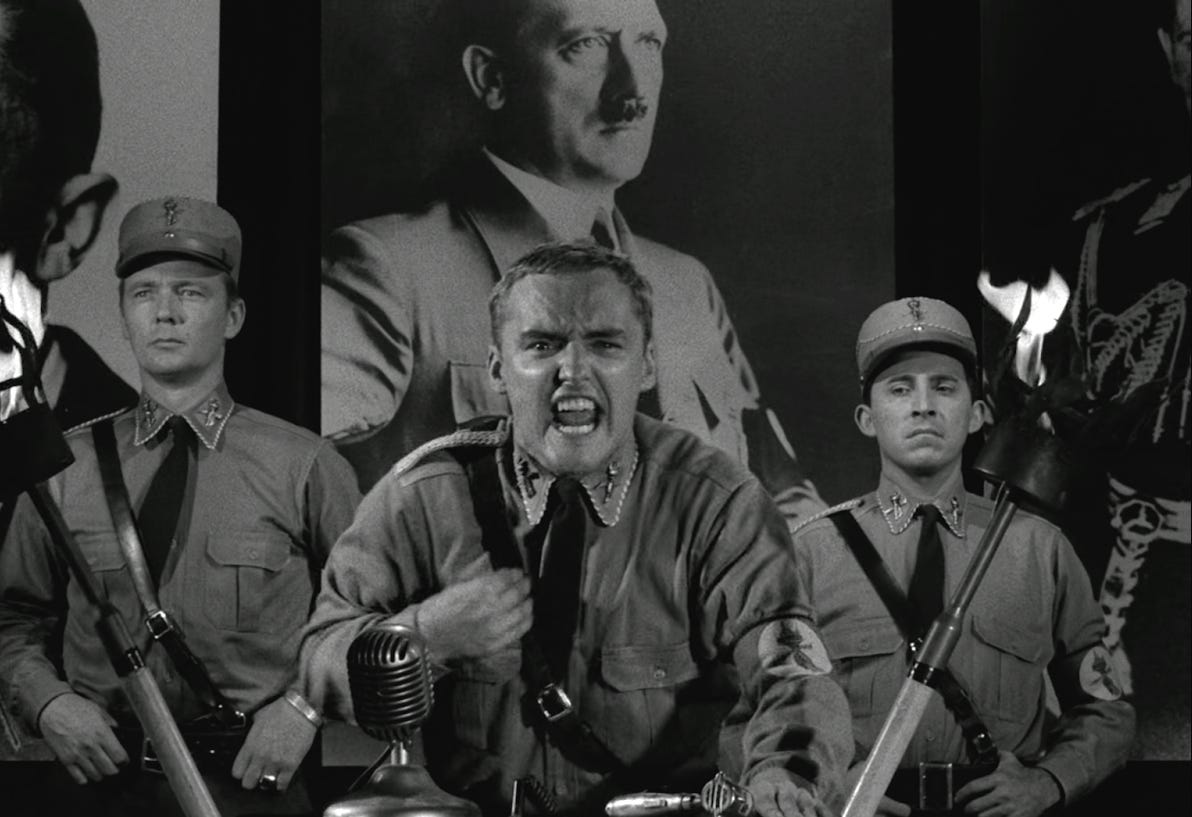
Trump’s evocation of Nazi propaganda is subtler, but not by much. A recent piece by Mehdi Hasan in The Guardian analysed the similarities between the imagery and rhetoric of Trump’s government and that of the Nazi Party in the 1930s, including a Department of Homeland Security video with the caption “One Homeland. One People. One Heritage”, directly referencing the Nazi propaganda slogan “Ein Volk, ein Reich, ein Führer”. Hasan identifies many similarities and covert (or not so covert) references to far-right propaganda, memes and tropes spread on social media by Trump and his cronies – references that his audience may or may not understand as fascist memes and images.
Vollmer’s unabashed fanboyism for the Nazi regime’s figureheads and imagery might stretch our modern credibility, but Serling’s script recognises that fascist ideas often appear unserious, or brash, and easily dismissed. When Ganz and a friend draw parallels between Vollmer’s speeches and their experience of watching the Nazi party rise in 1930s Germany, the friend argues: “It was another time, Mr Ganz. Another place. Another kind of people.” Ganz explains how the Nazis’ propaganda and posturing seemed at the time; a kind of “...temporary insanity, part of the passing scene, too monstrous to be real.” This carries echoes of our own time, as many liberals and leftists who offer parallels with 1930s fascism are denounced for having “Trump derangement syndrome” – something the Trump administration is now attempting to codify as a diagnosable mental illness. Even figures on the left dismiss other leftists’ concerns regarding the fascism of the Trump administration. Ganz continues: “…we ignored them or laughed at them. Because we couldn’t believe that there were enough insane people to walk alongside of them. And then one morning, the country woke up from an uneasy sleep, and there was no more laughter… The wild animals had changed places with us in the cage.”
As Ganz considers how to show his resistance to Vollmer, Hitler’s geist continues to counsel the aspiring dictator. He advises him to create a martyr to the cause: “You take one of no value, and you make him into a symbol. You wrap him in a flag, and you make his death work for you.” Following his advice, Vollmer orders one of his followers to kill another, and make it look like the killing has been carried out by an anti-fascist. The parallels with the killing of right-wing podcaster and ‘debate’ advocate Charlie Kirk, and his subsequent canonisation as a martyr and saint by Republicans, cannot be avoided. There was much debate online in the wake of Kirk’s assassination, with both poles of the political spectrum suspecting a psyop or “false flag”. Although it is not the point to support such an argument here, this phenomenon is of interest.
Ultimately, few conclusions can be drawn on whether Kirk’s shooter Tyler James Robinson was radicalised by either end of the political spectrum. His parents were registered Republicans, but Robinson’s politics emerge from a murkier world of online radicalism where mass shooters are rewarded for their viral fame, rather than their political beliefs, as Kyle Chayka argued in a piece for The New York Times. Robinson carved messages into the bullets he used to target Kirk, but those messages were open to interpretation: “One bullet said ‘Hey fascist! Catch!,’ then included a code for dropping a bomb in the video game Helldivers 2,” Chayka writes. “Another said ‘If you Read / This, You Are / GAY / lmao’… a third contained an emoticon-laced message drawn from furry subculture.” In particular, media coverage and online speculation focused on Robinson’s alleged relationship with a trans woman, and messages posted on Discord – both of which became fuel for the bonfire of conspiracy theories about whether he was a “redpilled” conservative or an “antifa” plant.
The martyring of one of Vollmer’s followers echoes the death of Horst Wessel in 1930. Wessel was a member of Hitler’s paramilitary organisation the Sturmabteilung (SA), nicknamed the “Brownshirts”, for whom Vollmer’s ragtag band of racists are a direct allegory. Murdered by Communist activists, Wessel was mythologised by the Nazi propaganda machine just as Trump’s followers mythologised Kirk after his death. Wessel’s murder was used to justify violence against Communist activists, and to encourage Nazi followers to lay their bodies on the line for the movement. The death of Vollmer’s follower has a similar effect, swelling the ranks of his crowd. The murder is explicitly a false flag – something much harder to prove than in the case of Kirk’s killer. It is devastatingly effective as a propaganda technique.
Similar false flag allegations were made after the attempted assassination of Trump by 20-year old Thomas Crooks in 2024. Like Robinson, Crook’s politics were hard to parse. He was a registered Republican, but does not seem to have been overtly political, let alone radicalised. More effective than rumours that he was an antifa shooter was the famous ‘Fight’ image of Trump, taken seconds after the shooting. This image became a powerful symbol, one that Trump’s campaign team used to devastating effect in the 2024 election, despite later ejecting the photographer Evan Vucci from the White House press pool. Vucci’s response to how the photograph was used and interpreted remain guarded: “So as far as how people view the images and how they market it, and how they use it for their own point of views, that’s none of my concern,” he told Time Magazine.
Spurred to action by the increasing popularity of Vollmer and his movement, Ganz storms their town hall meeting and delivers a powerful speech denouncing the ideology of Nazism. Many of the local crowd attracted by Vollmer’s charismatic rhetoric leave the hall. In the scene that follows, the actor Curt Conway steps into the light, revealing himself to Vollmer for the first time. Realising that the ghost who has been advising him is Adolf Hitler, Hopper’s face at first betrays surprise and shock – but at the Führer’s urging, he pursues Ganz to his apartment and shoots him dead. With his dying breath, Ganz still asserts his victory, saying: “You can never kill an idea with a bullet.” He is referring to the idea of resistance to fascist politics, but his aphorism cuts both ways – if either Robinson or Crook intended to silence their intended victims, the effect of their shootings arguably served to bolster the Trump movement’s popularity rather than diminish it. After the shooting, Vollmer flees from police and is killed resisting arrest – a conclusion that Serling will later complicate with the show’s trademark closing monologue.
Parallels between Vollmer and Trump are unavoidable. Like Vollmer, Trump’s speeches allude to the ‘Great Replacement’ theory, which speaks of white populations being supplanted by foreign invaders, sometimes at the behest of a shadowy Jewish elite. This conspiracy theory has deep roots, preceding even the Second World War, but its echoes persist in Vollmer’s insistence that America has been “infected with vermin from foreign shores”, and in Trump’s recent comments about Somalia as “filthy, dirty, disgusting, ridden with crime”. He argued in his speech in Davos to the World Economic Forum: “They’ve destroyed our country. And all they do is complain, complain, complain.” It also finds echoes in the chants of the far-right activists who descended on Charlottesville for the ‘Unite The Right’ rally in 2017, who led a torchlight procession with chants of “Jews will not replace us.”
While the militaristic occupation of cities like Minneapolis, Portland and Los Angeles by ICE agents may be turning the tide of opinion against Trump among certain segments of the US population, many are still susceptible to the dangerous false nostalgia of the promise to “Make America Great Again”. As Vollmer says, directly parroting Hitler’s ghost, many white Americans still consider themselves to be part of a threatened, increasingly minoritarian vanguard against foreign invaders and a corrupt liberal establishment: “Because patriotism is a minority. Because love of country is the minority. Because to live in a free, white America seems to be of a minority opinion.”
Trump’s evocation of a “free, white America” is increasingly self-evident in his appeals to the idea of a white ethnostate grounded in promises to deport over 100 million people – more than the current US population of first-generation immigrants. This shows the direction of travel. Trump’s administration is not focused solely on the goal of controlling or reversing immigration or “securing” US borders. Rather, it is the first wave of a push to create a majority-white America through forced “remigration” of anyone with a nonwhite background. In “He’s Alive”, Ganz gives voice to a patriotic, small-town American vision of egalitarianism, tolerance and decency – one that eventually triumphs over the heated, racist rhetoric of Vollmer. In today’s America, such faith in the ability of American traditional values to both recognise and triumph over Trump’s racist policies and beliefs seems, if not naive, then certainly beset with challenges. Just as with Vucci’s photograph, the symbols and values of American history and politics have been successfully bent to the purpose of the MAGA movement, allowing Trump to paint everyone from antifascist activists to students, teachers, lawyers and judges as “un-American”. It is difficult to imagine how this capture of American tropes and beliefs can be reversed, even if the Democrats manage to win in the 2028 elections.
After his speech, Ganz tells Vollmer: “An old man stopped you with a few words.” By pointing out the parallels between the ideas and rhetoric of Vollmer and Hitler, Ganz manages to win over at least some of the crowd, and expose the fear, weakness and cowardice of Vollmer to his public. Attempts by American journalists to draw such parallels between Hitler and Trump have largely failed – Anne Applebaum drew comparisons in a 2024 piece for The Atlantic, while academics from Berkeley and other universities have spoken at length about the similarities between 2020s America and 1930s Germany. Trump and his circle have used “Trump derangement syndrome” to derail such critics, or have hidden behind the joking, “post-ironic” posturing of edgelord meme culture to explain away racist messages from young Republicans leaked to the press.
Beyond the martyring of Horst Wessel, another key event ensured the consolidation of Nazi power – the arson-caused fire at the Reichstag in 1933 allowed Hitler to suspend civil liberties, and in short order, to end democratic elections by declaring a state of emergency. If the January 6 riots in 2021 can be considered Trump’s first attempt at a “Reichstag moment”, it is likely that more of the same can be expected. As Elliott Ackerman argues in a piece for Time Magazine: “Democrats have, largely, been unsuccessful in using the January 6 insurrection as a tool to hold their rivals accountable, but this doesn’t mean that such accountability — or even a purge of rivals — wouldn’t be possible under similar conditions; if, say, a January 6-style attack on institutions were to repeat itself with different, more ruthless political leadership at the helm of American institutions.”
As the 2026 midterm elections draw closer, the likelihood that Trump may choose to engineer or co-opt further moments of civil unrest to justify the erosion or suspension of democratic norms seems almost inevitable – and self-evident in his government’s labeling of the decentralised, anarchist-affiliated antifa movement as an organised terror group, just as it is in J.D. Vance’s labeling of Renee Good as a “domestic terrorist”. Unlike Vollmer’s incipient movement, Trump’s shock troops don’t need to stand in front of pictures of Adolf Hitler, nor do they wear uniforms – they are recognisable in the anonymous masked appearances of ICE agents, or prior to his election, the Fred Perry-adorned Proud Boys. Like the Nazi party’s Schutstaffel (SS), Trump’s ICE agents act as an unaccountable, ever-present military presence in American cities. Groups like the Proud Boys, the Oathkeepers and other smaller groups have all played the part of American Brwonshirts, both in the January 6 riots (for which their members were charged and indicted by the Biden administration, then pardoned and released by Trump), and in subsequent street-level clashes with anti-Trump protestors.
Trump supporters in the mainstream of American politics seem able to ignore or look away from the regime’s worst excesses, either writing off his fascist propaganda as an elaborate form of trolling, or simply ignoring the consequences of his ideas and policies when they contradict their own democratic, Christian or libertarian beliefs. On the resistance side, there seems to be a belief that mimicking the extremely-online, populist approach of the Trump movement is the way forward, as evidenced by the all-caps posts disseminated by California Governor Gavin Newsom’s media team. Such efforts seem doomed to fail in their attempts to recapture the zeitgeist of American media and discourse.
The right wing still holds a position of cultural dominance, whether through the normalised fascist rhetoric of podcasters like Nick Fuentes, the naked trolling of Kanye West’s song Heil Hitler, or via the hipster literati of Dimes Square, who (ironically or not) have aimed to reclaim avant garde literature for the right. The reaction to an era where so-called ‘woke’ values dominated American public life seems to have continued public support, with some liberals and leftists initially backing the Trump team’s push to rid academia of diversity initiatives, positive discrimination and identity politics.
Against a backdrop of growing authoritarianism worldwide, many critics of Trump, Viktor Orban, Vladimir Putin and other proto-fascist figures seem reluctant to speak up at all, as Mike Watson pointed out on the Revol Press blog this month. Perhaps most significantly, the Trump administration is deeply connected to, and funded by, the billionaire class of “Dark Enlightenment” reactionaries in charge of big tech. Figures like Peter Thiel seem to have missed the message that the cyberpunk genre was a dire warning, and not a roadmap to an undemocratic, fascist future. Inspired by the ideas of Curtis Yarvin, Nick Land and others, the Trump administration is powered by a deep undercurrent of accelerationism. This should come as no surprise to anyone with a passing familiarity with the history of 1930s Germany, where companies lined up to fund, arm and support the Nazi party.
This capture of big tech, culture, academia and media has far-reaching consequences, serving to both normalise Trump policies, and to save his administration from doing the heavy lifting to win over hearts and minds. As Robert Reich points out, the capture of these institutions means they serve as “mechanisms for giving the Trump regime power to prevent these institutions — a television network, university, or corporation — from doing something that the Trump regime doesn’t want it to do. But because that power is held in reserve, Trump doesn’t have to display it. The heads of these institutions will do all the work for him; they’re likely to go out of their way to avoid offending the regime. The potential chilling effect is enormous.”
In “He’s Alive”, the would-be dictator is shot, and his revolution stopped in its tracks. As Rod Serling underlines in his closing monologue, this far from assures that the malign ideas, approaches and tactics of fascist movements have also been defeated. They persist, haunting the imaginary of democracies and inspiring the actions of autocratic regimes. Trump doesn’t need a ghost whispering in his ear. He has already captured the geist – the spirit of the times, and the imagination of a large swathe of American voters. Who will speak against him, and be heard and understood, in a climate of open disaffection with politics, economic policies, and politicians of all stripes? A skilled and charismatic orator, Trump continues to speak in the idiom of jokes, but rules through paramilitary and extrajudicial fiat. He’s already got the crowd behind him – for many of his supporters, like Mussolini, Trump is never wrong. He’s always been a racist, but that no longer seems to matter much. Our disillusion with neoliberal democracies, and the dangerous power of false nostalgia, have combined to make him unassailably powerful, at least for now.
We cannot escape Hitler’s geist unless we remember the lessons of history – but sadly, the last generation of men like Ernst Ganz, who carry with them the memory of the death camps and pogroms, are all but gone. Without them, who will step forward and carry the message embodied in Rod Serling’s epilogue for this enduringly relevant episode of The Twilight Zone: that we must remember not just the atrocities of fascism, but their origins in populist narratives of hate and disunity?
Serling’s final monologue makes clear that despite the death of one leader, and potentially his whole movement, Hitler’s geist remains: “Where will he go next? This phantom from another time, this resurrected ghost of a previous nightmare… Anyplace, everyplace, where there’s hate, where there’s prejudice, where there’s bigotry. He’s alive. He’s alive so long as these evils exist. Remember that when he comes to your town,” Serling urges us. “Remember it when you hear his voice speaking out through others. Remember it when you hear a name called, a minority attacked, any blind, unreasoning assault on a people or any human being. He’s alive because, through these things, we keep him alive.”