
Hypercapitalism and its Discontents
Bram E. Gieben on the dangerous rise of political violence, and what it can tell us about resistance to capitalism in the accelerationist age


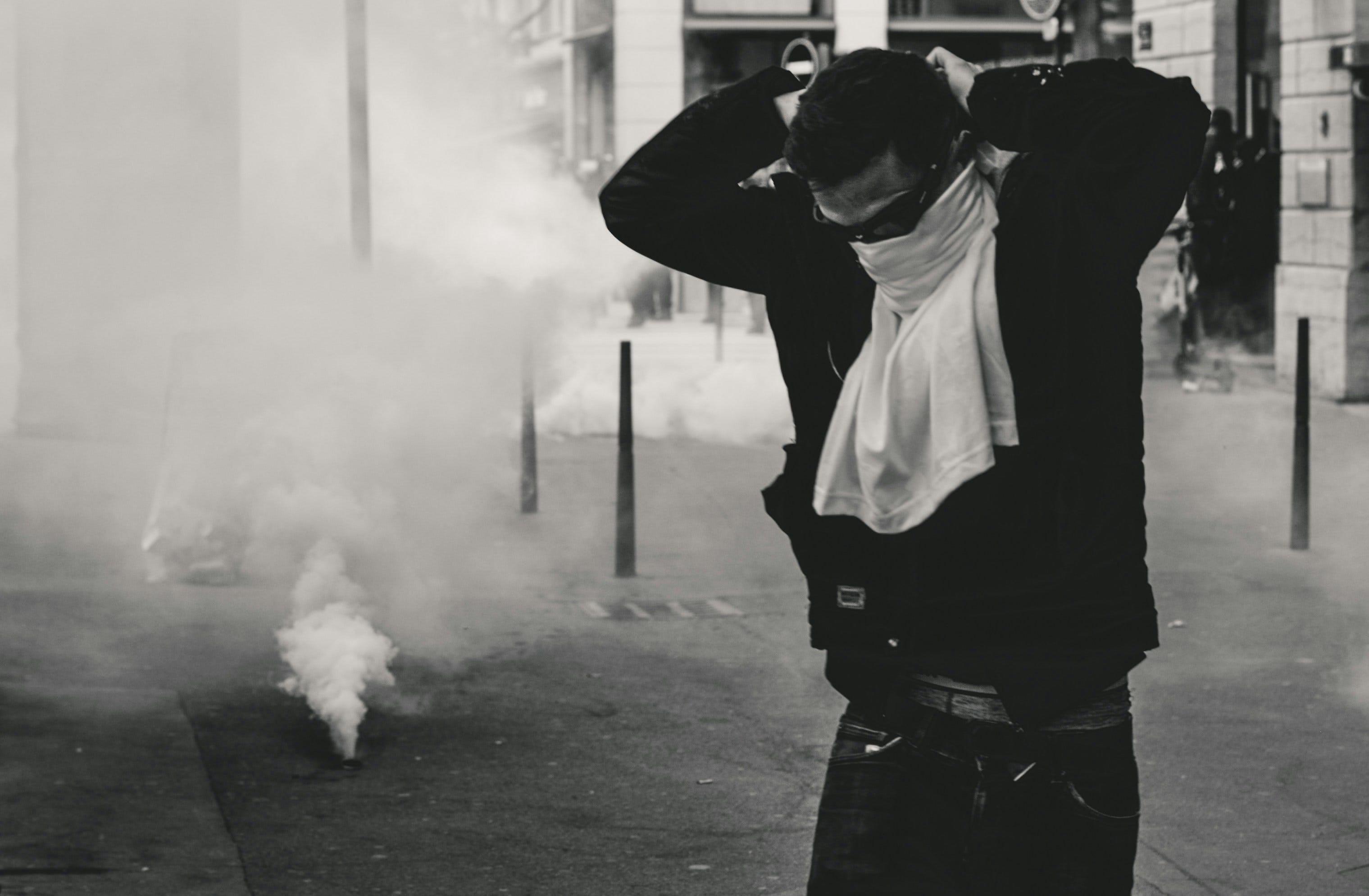
The 2025 killing of a US Border Patrol agent by members of an alleged “rationalist” cult, later connected to three more murders, was linked to the ideas of programmer and AI expert Ziz La Sota1 — a fringe figure in Silicon Valley, convinced of the need to save humanity from a malign artificial intelligence in the far future. Tyler Robinson, the killer of right-wing activist Charlie Kirk, carved messages into the bullets he carried. They included references to the “furry” kink subculture, ant-fascist political memes, and the space combat game Helldivers 2.2 Incel mass shooters Eliot Rodger, Christopher Harper-Mercer and Alek Minassian all published some form of manifesto online before committing their atrocities. The killing of health insurance executive Brian Thompson by Luigi Mangione was ideologically motivated, and carried out with a 3D-printed “ghost gun” sourced online.
Axel Rudakubana, who murdered three young girls in 2024 in Southport, was initially misreported as being a radicalised Islamic extremist, leading to widespread anti-immigrant riots in the UK. When it was revealed to the public that he was not a Muslim, questions began to be asked about how the UK’s counter-terrorist Prevent programme, designed to catch radicalised teens before they commit violent acts, could be updated to identify those inspired by ideologies more obscure and less coherent than Islamic fundamentalism.3 Rudakubana was referred three times under the Prevent scheme, but he was not “radicalised” in a way that fit into a neat ideological box — so the referrals led nowhere. The surveillance of children by their teachers as part of the Prevent scheme was an ineffective tool for preventing his alienation, radicalisation, and the violent acts that transpired.
Explicitly political violence, and violence inspired by new and strange ideological forms, is rising, and states have attempted to respond. Whether you consider the extra-judicial killings of Alex Pretti and Renée Good by ICE agents in Minneapolis, the race riots that rock Britain with disturbing regularity, the imprisonment and mistreatment of UK protestors speaking out to support Palestine Action, or the assassination attempts made against Donald Trump in 2024 and 2025 as all part of the same trend is a matter for debate. As the stakes rise and unrest grows, it is getting harder and harder to parse the ideologies that inspire mass shooters, spree killers, and the perpetrators of state-sponsored violence. Even the US government indulges in extra-judicial killings, assassinations and kidnappings, while shit-posting Nazi-inspired memes.4 Lone wolves often become heroes online, sometimes inspiring further violence. Are we doomed to be trapped in a spiral of polarisation, radicalisation and violent chaos?
As the threats of climate collapse, rising political instability and the problems that come with new technologies like artificial intelligence intensify, we may in all likelihood face the prospect of more ideologically-inspired violence — more manifestos, more shooters, and more surveillance of (and brutal crackdowns on) “domestic extremists”, sanctioned by our governments. How do we engage with the substantive aspects of the critiques of society these violent acts represent, let alone understand how radicalisation works when it is not connected to an ideology we have seen before? We cannot afford to write these killers off as monsters, and ignore the ideas that motivate them – any more than we can take at face value the motivations of groups like Tommy Robinson’s English Defence League, or the confederacy of right-wing figures pushing ICE purges in the US.
The outsider is sometimes the only person permitted to speak the truth. In the opening lines of what came to be known as the Unabomber Manifesto, Ted Kaczynski wrote:
The Industrial Revolution and its consequences have been a disaster for the human race. They have greatly increased the life-expectancy of those of us who live in “advanced” countries, but they have destabilized society, have made life unfulfilling, have subjected human beings to indignities, have led to widespread psychological suffering (in the Third World to physical suffering as well) and have inflicted severe damage on the natural world.5
The evidence for this proposition is all around us. Despite the borderline psychotic, libertarian, racist and misogynistic currents in his writing, Kaczynski’s manifesto nonetheless confronts us with difficult truths. His murders obscure and problematise these arguments, of course — his ideas are mostly lost to his actions. But undeniably Kaczynski wrote lucidly about how technology would usher in unprecedented influence and control over authentic human agency and thought. On that topic, his predictions and provocations continue to prove prophetic, even as we seek to distance ourselves from the extremists who increasingly influence, dominate and terrorise our political life and culture.
In the manifesto, Kaczynski mentions “the system” multiple times — this could easily be read as a stand-in for capitalism, the machine driving not just ecological catastrophe, but also unchecked technological accelerationism. It might be reductive to characterise Kaczynski as an anti-capitalist, but we can ill afford to ignore the salient points he made about how what he called “the system” drove him to take such violent actions, escalating from acts of sabotage and anti-corporate vandalism to a bombing campaign which claimed the lives of three people, and injured many more.
Just like the science fiction writer William Gibson, who began his equally prescient 1984 cyberpunk novel Neuromancer on a typewriter, Kaczynski did not create his manifesto electronically. It was hand-typed on a portable Smith and Corona, later auctioned for close to twenty-five thousand dollars.6 Industrial Society and its Future was published in 1995 just as the acceleration of digital media and technology began to usher in unprecedented changes to the sphere of human interaction.

Unlike Gibson, whose later work would increasingly focus on surveillance, Kaczynski was perhaps unable to see clearly that digital tracking technologies — and later our voluntary submission to real-time tracking via social media — would be one of the principal ways in which human agency would be undermined and controlled. His manifesto mentions surveillance just four times; the discussion of it passed over briefly in reference to CCTV. The deeper layer of invasive surveillance and digital presence that would be the direct descendant of the almost-total CCTV coverage in cities like London, already extant in the 1990s, was not yet visible in Kaczynski’s dire prognostications about technology’s malign influence on us. It is difficult not to wonder what he made of the internet, smartphones and digital media from his cell in Florence, Colorado in the years before his death in 2023.
As climate collapse continues almost unabated, the possibility that others might follow in Kaczynski’s footsteps, as Alek Minassian followed in Eliot Rodger’s, is increasingly high. In a 2017 piece for Foreign Policy about the possibility of a coming rise in “extremist” environmental activism, the journalist Jamie Bartlett wrote:
It’s not clear how society ought to respond to a new wave of environmental extremism. So far, previous waves of extremism have encouraged us to believe that radicals and extremists are always misled, confused, irrational, manipulated, or evil — not rational thinkers who have made their decisions based on a combination of scientific data and utilitarian philosophy. The tools we’ve developed to counter radicalization are based on these assumptions.7
Bartlett is likely correct when he argues that we are ill-prepared for the return of environmental activism of the kind Kaczynski’s murders foretold. In a 2018 piece for Intelligencer that includes interviews with Kaczynski from his jail cell, John H. Richardson writes of the movements already following in Kaczynski’s footsteps:
They cluster around a youthful nickname, “anti-civ,” some drawing their ideas directly from Kaczynski, others from movements like deep ecology, anarchy, primitivism, and nihilism, mixing them into new strains. Although they all believe industrial civilization is in a death spiral, most aren’t trying to hurry it along.8
As Richardson says, most of the groups he spoke to for his piece are focused on the climate aspects of Kaczynski’s thought, often centring on his goal of a return to pre-Industrial Revolution levels of technology — and for the most part, they do not endorse violence. Whether this will continue to be the case is what both Richardson and Bartlett question. But like Kaczynski himself, few of these new activist groups focus their concerns or their analyses on surveillance, and the increasing degree to which we are subjected to invasions of our privacy thanks to the technologies on which we have come to depend, from artificial intelligence to the algorithms of social media. And yet, when governments talk of how to counter extremism, it is often to propose increased surveillance and monitoring of their populations.
What William Gibson foresaw and what Kaczynski only dimly appreciated was the degree to which technological presence and the data-mining of our every waking thought would become not just a common factor of modern societies, but a desired outcome. The life of total surveillance is one we participate in, for the most part, with consent. That consent is expressed through our buying choices, and the technological brands we consume. This consent functions differently in autocratic, totalitarian societies than in notionally democratic ones. In China, invasive surveillance of the population is guided directly by the state. In democracies, it is guided by corporations, as Gibson and other cyberpunk writers predicted.
There is more similarity here than difference. In every state, from the most brutal dictatorship to the most democratic republic, human beings are manipulated, controlled and policed in every aspect of our existence with increasing force and invasive surveillance. In democratic societies, the right to protest, participate in public debate, or publish and be damned is under unprecedented threat. Writers, activists and academics alike are caught between two impossible and irreconcilable poles. On the one hand, there is the legislative overreach of campaigns to protect statues of slave traders and demagogues, or the free speech of bigots. On the other, there is the emergence of an increasingly febrile and censorious arena of public debate, stoked and inflamed by a media, academic and political class obsessed, at both political extremes, with the language of the so-called “culture wars”.
This atmosphere has had a stifling effect on activism and debate, and it has devastated solidarity across activist causes. The always-delicate alliance of people with liberal, progressive, utopian and revolutionary values, in the shared pursuit of ideas of community and universalism, is shattered. Resistance to autocratic, anti-democratic and actively hateful ideologies has been effectively atomised — even the anti-Trump “resistance” movement is riven with division and disagreement, often splintered into bitterly opposed camps of activists who should by all rights share concrete goals and aims. The boundaries of acceptable ideology have always been patrolled, not just in public discourse, but by the policemen in our heads.9 In the current moment, dogmatic voices have become so loud as to drown out sense, solidarity, and common human feeling. Increasingly, those engaged and “radicalised” by ideologies are instead turning towards violence.
Those of us who live in notionally democratic states have passively consented to be controlled by technology, to live under constant surveillance, and to be subject to the unquestioned ideology of hypercapitalism. For some, realising this can come not as a liberating epiphany; the man behind the curtain revealed. It is instead a dawning horror. Disillusionment makes you an exile. The “choice” and “consent” exercised by the radically-decentred capitalist subject is a false choice, and therefore no choice at all. Our only true choice is that of brands, identities and lifestyles, each defined within the strict correlates of success-or-failure capitalist metrics. The crux of this is an unexamined faith in meritocracy, and the fairness of the market.
How does one opt out? Non-participation by the denial of consent makes you an outsider, a pariah. Depression can follow this realisation, and the experience of “othering” or rejection from the societal mainstream, an activist movement, or a political philosophy. Sometimes violence is the direct consequence.
Crazy right-wing ecofascist lunatic or not, Kaczynski was on to something. Conformity and competition are indeed the conditions of capitalism, and since the transition from industrial capitalism to exponential-growth, technologically-driven hypercapitalism, this has only intensified. The ruthless Social Darwinism that was renewed in Thatcher and Reagan’s toxic neoliberalism has now become the norm not just in economics and politics, but in human psychology. You either embrace this pragmatically, or you will be crushed.
Ruthless self-interest and a belief in a tendency towards competition, specialism and tribalism in human beings now manifests as uncontrolled extractivism, and the disruptive market terrorism of technological accelerationism. And yet, the knowledge that this is a created ideology, one that is self-sustaining, and ultimately toxic to the existence of all biological life on this planet, is an increasingly insurgent mainstream point of view. Whatever the norm is, and however the loosely-defined coordinates of our current era’s “common sense” narratives were arrived at, growing numbers of people are beginning to question both. From within our filter bubbles, it is almost impossible to gauge where possibilities for change might exist within the bounds of civil society and non-violent political action.
Capitalism has strangled effective activism, and radicalisation is the direct result. As writers of the Situationist International such as Mustapha Kayati apprehended in the 1960s, the existence of alternative modes of illusion, from theocracies to dictatorships, are merely a cracked mirror to what Kaczynski called “the system”:
In spite of apparent variations and oppositions, a single social form dominates the world. The principles of the old world continue to govern our modern world; the tradition of dead generations still weighs on the minds of the living.10
In The Society of the Spectacle, Guy DeBord’s searing dissection of a media-saturated, image-fixated culture, he writes of the ways in which this “old world” power manipulates and subverts any and all opposition and resistance to it. DeBord’s Spectacle society absorbs attempts to seek power by those who do not already possess it:
Complacent acceptance of the status quo may also coexist with purely spectacular rebelliousness — dissatisfaction itself becomes a commodity as soon as the economy of abundance develops the capacity to process that material.11
The point is not that certain people have power and control, and therefore they are the enemy. That is the first mistake most people make when they analyse power relations. The point is that in the chaos of the world we inherit, bad actors and malicious, selfish interests find it all too easy to manipulate us to their own ends. Rather than persecute or bring violence to them, we must enlighten ourselves, or risk becoming “conspiracy theorists” of one kind or another. It doesn’t matter who’s behind 9/11, or whether Jeffrey Epstein killed himself. It matters who profited from it, who had what intelligence, who appropriated an event’s symbolic weight for their own agenda. The story is more spectacular than the truth. Perhaps our artists know this best.
As Alan Moore says:
Conspiracy theorists believe in a conspiracy because that is more comforting. The truth of the world is that it is actually chaotic. The truth is that it is not The Illuminati, or The Jewish Banking Conspiracy, or the Gray Alien Theory. The truth is far more frightening. Nobody is in control. The world is rudderless.12
Perhaps Moore is even being optimistic when he says “nobody” is in control. Rather, control is held by those who have always held it — those who have successfully sought and held power, sometimes for generations, sometimes for hundreds of years. If there is a conspiracy, it manifests as a vast, time-spanning web of secrecy and complicity in service of the protection of individual legacies. The value of these legacies, and the power of those who control them, has increased in the past few decades. The political interests of the individuals concerned do not necessarily manifest in the same monolithic way that the Chinese state does, or that American military might did during the Cold War, but they are just as powerful and influential, if not more so. The interests of capital, which is to say the interests of the rich and the powerful, are concealed behind layers of opaque mystery through tactics like offshoring, legal tax loopholes, and soft forms of inherited wealth; from home ownership to the “family business” of Hollywood “nepo baby” celebrity.
As the whistleblower Edward Snowden wrote in 2021:
Counterintuitively, these conspiracies are more often than not announced in public and with a modicum of pride. They’re dutifully reported in our newspapers; they’re bannered on to the covers of our magazines; updates on their progress are scrolled across our screens — all with such regularity as to render us unable to relate the banality of their methods to the rapacity of their ambitions... This, in sum, is our problem: the truest conspiracies meet with the least opposition… We talk about conspiracy theories in order to avoid talking about conspiracy practices, which are often too daunting, too threatening, too total.13
To single out a figurehead such as Bill Gates, Elon Musk or George Soros as the exemplary of this economic and cultural power is to miss the point. They are just avatars of the interests of capital. It is their job to argue that capital’s dominance is not just inevitable, inexorable and assured, but that it is also just and enlightened. They are the salesmen — billionaire carpetbaggers. They are not the company. They are not the money, not big-C ‘Capital’ — just its utterly disposable envoys. Their “conspiracy” is too big to miss, too powerful to meaningfully fail. Its avatars, if executed, are simply replaced, Hydra-like, by new, smiling automata.
The way in which we suppress and avoid this realisation is expressed fully in Mark Fisher’s Capitalist Realism when he writes:
At the level of the political unconscious, it is impossible to accept that there are no overall controllers, that the closest thing we have to ruling powers now are nebulous, unaccountable interests exercising corporate irresponsibility… the centrelessness of global capitalism is radically unthinkable.14
Capital’s ability to nonetheless control and define a rudderless world is the story of its dominance and indomitability. If the rudderless nature of the world and history, and by extension our lives is truly “unthinkable” then it is where we must begin our thinking. This starts with the realisation that if the world is truly rudderless, powerful interests have already — and will continue to — step into the void this creates. We are often powerless to do anything but observe this as subjects, as Fisher states:
Capitalism is what is left when beliefs have collapsed at the level of ritual or symbolic elaboration, and all that we have left is the consumer-spectator, trudging through the ruins and the relics… A detached spectatorialism replaces engagement and involvement.15
What shapes this belief that we are powerless? What ideas inform it? In whose interest is it that we consider ourselves to be passive spectators, and how can we avoid despair at this conclusion? How do we escape the feeling that because we are powerless, nothing matters? Where do these feelings and questions lead, except to the belief that violence is the answer?
The failure to address such questions is what will produce a new generation of Kaczynskis — with all the same flaws in thinking, and the same risks to public safety. The ideologies of the Zizians, lone figures like Luigi Mangione or Charlie Kirk’s killer, Islamic fundamentalists, and even incel killers must be understood if they are to be countered. The issues they identify must be addressed in a clear-eyed way.
If the only approach to mitigating these risks is more surveillance, the problems will not just remain, but increase exponentially. We, as technological consumers, voluntarily participate in the creation and maintenance of a system that seeks to ensure our control and compliance, even while it drives division between activist movements who desperately need solidarity to achieve their ends, and discounts the ideas of radicalised killers as “insane”, “monstrous” or “extreme”.
Which is more dangerous — an ideology we understand and perhaps even sympathise with, like that of Ted Kaczynski or Luigi Mangione? One we don't, like those of Ziz La Sota, or Tyler Robinson? What about when motive or ideology are absent or inscrutable, as with Axel Rudakubana — how are we to understand such events?
Perhaps in our current moment, as Freddie DeBoer writes:
… political violence is not the product of ideology but rather an attempt to will ideology into being through violence itself. To create meaning in a culture steeped in digital meaninglessness by the most destructive means available.16
Escaping a future where thousands of Kaczynskis hold us hostage through violence means rejecting what Byung-Chul Han has called the “digital panopticon”17 — where new, malign ideologies evolve, fester and metastasize; and where total surveillance is the only solution we can imagine. Once more, we must find community in the real world. It is here that we can challenge the avatars of capital, and perhaps find ways to counter their centuries-long dominance of our thoughts, actions and ideologies. Unless we find a way to do this, we may already be approaching a future where more of us see the fatal logic in picking up a gun or a knife to make a difference, find meaning or purpose — or to change the world.
Bram E. Gieben published The Darkest Timeline with Revol Press in 2024. He hosts the philosophical podcast Strange Exiles, where he is currently publishing the ongoing essay series Crisis Masculinity, exploring male identity under late-stage capitalism. His next book for Revol is anticipated in 2027.
For more on the Zizians, see: Christopher Beam, “She wanted to save the world from A.I. Then the killings started”, New York Times, 7 Jul. 2025.
See: William Brangham and Mike Fritz, “A look into the online subcultures tied to Charlie Kirk’s accused killer”, PBS, 16 Sep. 2025.
See Ali Breland, “The Trump Administration Is Publishing a Stream of Nazi Propaganda”, The Atlantic, 21 Jan. 2026.
Ted Kaczynski, “Industrial Society and its Future,” Washington Post, 19 Sep. 1995.
Source: The Ted K Archive.
Jamie Bartlett, “The Next Wave of Extremists Will Be Green”, Foreign Policy, 1 Sep. 2017.
John H. Richardson, “Children of Ted: Two decades after his last deadly act of ecoterrorism, the Unabomber has become an unlikely prophet to a new generation of acolytes”, New York Magazine / Intelligencer, 11 Dec. 2018.
“Kill the cop in your head!” is a slogan from the 1968 Paris uprisings, sometimes attributed to the philosopher Louis Althusser.
Mustapha Kayati, “On the poverty of student life: A Consideration of Its Economic, Political, Sexual, Psychological and Notably Intellectual Aspects and of a Few Ways to Cure it,” Situationist International, 1966.
GuyDeBord, The Society of the Spectacle, 1992 edn. (Rebel Press, 1967), p29.
Quoted by Dez Vylenz (director), The Mindscape of Alan Moore, Shadowsnake Films, 2003.
Edward Snowden, “Why do conspiracy theories flourish? Because the truth is too hard to handle,” The Guardian, Jul. 1, 2021.
Mark Fisher, Capitalist Realism: Is there no alternative? (Zero Books, 2008), p63.
Fisher, Capitalist Realism, p4-6.
Freddie DeBoer, “Constituent Parts of a Theory of Spectacular Acts of Public Violence”, Substack, 15 Sep. 2025.
Byung-Chul Han, The Transparency Society (2015, Stanford Briefs).