
Acid Extremism Now!
Rob Faure Walker, author of 'Radical Jung', on the legacy of Mark Fisher's 'Acid Communism' and the power of psychedelic exploration.


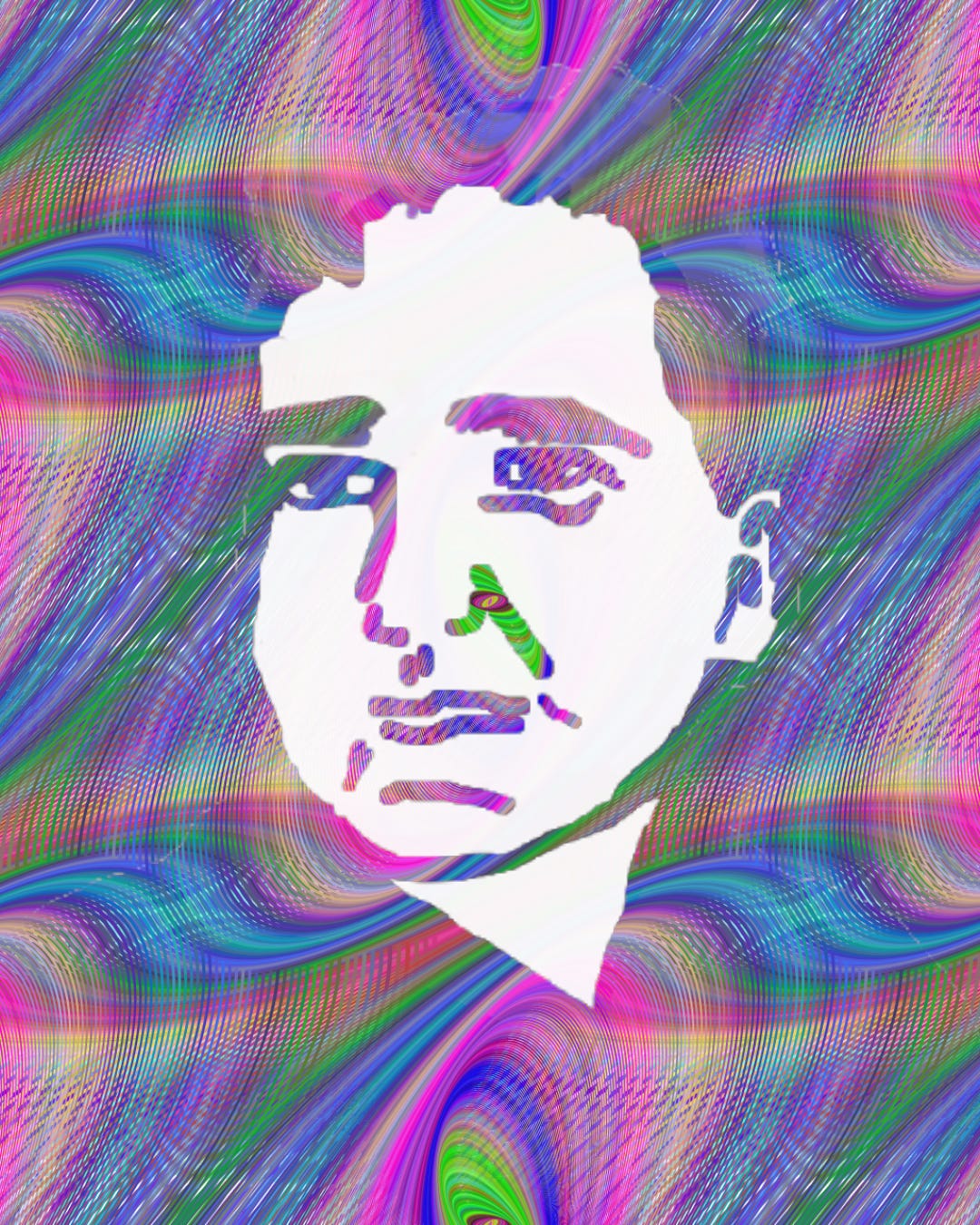
When Mark Fisher died, he left behind an introduction to a book that he would not finish. He describes naming this book Acid Communism as “a provocation and a promise. It is a joke of sorts, but one with a very serious purpose”. This purpose, as he lays out in his parting gift of writing to us, is to explore the counterculture of the 1960s as a “stumbling beginning” rather than the “best that could be hoped for”. The failure of these beginnings according to Fisher was precipitated by the failure of the left to engage with “the dreaming that the counterculture unleashed”.1
The tragedy that we are left with is that this germ of a collective utopia was destroyed by the release of a new aggressive form of capitalism or “neoliberalism” in the 1970s. Since then, we have watched neoliberalism subvert and colonise any remaining countercultural trends. Environmental consciousness has been claimed by corporations as cover for their millenarian growth at all costs, even at the cost of the collapse of the ecological and climate systems that we all rely on. The World Wide Web that was meant to be “for everyone” has been colonised by a handful of impossibly vast corporations whose aim is to destroy our political futures. Even the language of the counterculture has been co-opted. In the 1960s, to be described as a “woke” by civil rights organisers and members of the Black Panthers was to be praised for your understanding and empathic connection to those who didn’t look or think the same as you did. Yet today, “woke” is more likely to be used as a slur against anyone who dares to express empathy or care for others.
Radical politics promised a better future in the 1960s. But even this word, “radical”, has since undergone a slow transition via west coast surfers and cartoon reptiles to now be used by the state to describe the imaginary “radicalisation” process by which people develop their opposition to the neoliberal state. This process is imaginary as it supposes that people become opposed to political norms due to their infection by the ideas of others, rather than by their increasing consciousness of the injustices met out by systems of capitalism and colonisation.2
At the height of the British Empire, the west got rich off the suffering and murder of millions of African slaves and the plunder of India and elsewhere. In my previous work, I have explored how the word “extremism” was almost non-existent in the press and politics until the 1960s. It became more common in the 1950s when it was used to denounce anyone calling for an end to British rule abroad. Hence, Kenyan politicians calling for the British to leave Kenya are cast as “extremists”, likewise in India and anywhere else calling for an end to British colonisation of their lands. As with so many colonialist police tactics, “extremism” has since crept home to be used to denounce and ignore anyone calling for radical change to the way we do politics. Call for an end to corporate behaviour that could lead to an end of human life on earth and you might be cast as an “extremist”. Speak out against genocide, “extremist”. Question the legitimacy of the UK’s parliamentary democracy, “extremist”. Accusations of “extremism” are now the standard tactic by which dissent is shut down, with governments around the world being encouraged by the United Nations to develop their own strategies to tackle “extremism”.3
A system that seeks to pathologise “extremism” is a system that seeks to control what we think. This is a system that has grown since the 1970s to stymie any of the countercultural possibilities that were tentatively emerging in the 1960s. An early and powerful voice against the normative trend of neoliberalism was the maverick Jungian psychiatrist R.D. Laing. Known as the “acid Marxist” and “high priest of anti-psychiatry”,4 Laing observed that: “…sanity today appears to rest very largely on a capacity to adapt to the external world — the interpersonal world, and the realm of human collectivities”.5 Like “extremism”, Laing regarded sanity and madness as a hegemonic construction. Working with patients who had often been abandoned by the mental health system, Laing was able to help them find meaning in experiences that other professionals had cast as psychotic. His interest in acid stemmed from a belief at the time that psychedelics mimicked actual psychosis, the psychotomimetic model.
This idea that psychedelics mimic psychosis has since gone out of fashion as academics and corporations, seeking to promote the health-giving benefits of these chemicals, try to make them as palatable as possible to investors and the general public. Yet, as Laing and many others know, great meaning and purpose can be found in visionary states, whether sober and psychotic or chemically induced and psychedelic. This is because, whether they are purposefully induced by psychedelics or unintentionally emergent through psychosis, visionary experiences connect us to the unconscious.
As almost every worldview outside of western modernity knows, there is great wisdom and guidance to be found if we learn how to understand and integrate the symbolic meaning behind visionary states and dreams that emerge from the unconscious. With the guidance of indigenous thinkers such as Melissa Lucashenko and Tyson Yunkaporta,6 and more enlightened psychiatrists,7 we learn that the guidance that we receive from the unconscious leads us towards a more harmonious way of being with nature and with each other.
Despite this, the father of deep psychology, Carl Jung was “greatly opposed” to the use to psychedelics in psychiatry, fearing that users might be lost to the unconscious.8 Yet, in the UK through the 1960s and 70s, a psychiatrist was quietly giving LSD to psychiatric patients. Ronald Sandison developed a protocol where he gave LSD to his patients before engaging them in Jungian psychotherapy that included art therapy and extended group analysis. In doing so, Sandison and others had great success in helping people troubled by depression, anxiety, and psychosis to recover their agency over their lives and actions.9
Sandison and other’s work and research into the therapeutic use of psychedelics was rudely cut short by the war on drugs in the 1970s. Three decades later, research into these chemicals tentatively restarted and we are now seeing a corporate race to invest and cash in on these powerful chemicals. With corporate funded research seeking to develop new chemical variants of classic psychedelics such as LSD that offer the original chemicals’ healing potential without the patient having to suffer the inconvenience of a day-long acid trip.10 Other areas of interest are microdosing to increase productivity at work11 and tech bros turning to ayahuasca to recover from burnout and maintain their megalomanic trajectory.12
These uses of psychedelics, to enable our continuation in the extractive neoliberal economy, work against Fisher’s “dreaming that the counterculture unleashed”. Dreaming is what happens when we suspend our ego. When we suspend that part of ourselves that wants to fit in with the tribe, wants to do better at work, and to impress others. While psychedelics can catalyse this process of “ego death”, we don’t need these chemicals to achieve this. Yet, in a world of mortgage repayments, precarious employment, and social media, suspending our ego can be very hard to achieve as it demands that we step outside of sanctioned ways of thinking and risk being accused of madness.
Yet, it is only by taking this leap of faith into the unconscious that we have a chance of continuing the dreamings of something better that were tentatively explored in the 1960s. This may of course see us cast as mad and then, as political ideas emerge from this apparent madness, we might be labelled as “extremist”. In my forthcoming book Radical Jung, I explore the emancipatory possibilities of this dance with madness. If we are to avoid the pathologisation of the ideas that come from this great adventure, we must take back the language that will otherwise be used against us. This is why calling for “Acid Extremism Now!” is a joke and a provocation with a very serious purpose.
Radical Jung: Emancipatory Politics and the Search for Meaning in the Ruins of Late Capitalism is out now from Revol Press.
Rob Faure Walker is a writer, theorist and ecotherapist. His first two books are 2024’s Love and The Market, and 2022’s The Emergence of Extremism.
Mark Fisher, Acid Communism (unfinished introduction).
Rob Faure Walker, The Emergence of Extremism (Bloomsbury, 2021).
UN, “Countering violent extremism and terrorist narratives” (UN, 2022).
Ben Child, “David Tennant to play ‘acid-Marxist’ psychiatrist RD Laing in biopic” (Guardian, 2015).
R.D.Laing, The Politics of Experience, and, The Bird of Paradise (Penguin, 1967), 116.
Tyson Yunkaporta, Sand Talk (Text, 2019); Melissa Lucashenko, Edenglassie (University of Queensland Press, 2023).
Gail Hornstein, Agnes's Jacket: A Psychologist's Search for the Meanings of Madness (Routledge, 2009).
Ginny Hill, “Ronald Sandison in Zürich” (Wiley, 2024).
Ginny Hill, “Jung, the Rebirth Motif and Psychedelics” (Wiley, 2024a); Greg Mahr and Jamie Sweigart, “Psychedelic Drugs and Jungian Therapy” (Journal of Jungian Scholarly Studies, 2020); Torsten Passie et al., “Lower-dose psycholytic therapy – A neglected approach” (Frontiers, 2022).
David E. Olson, “Psychedelics without the hallucinations: A new mental health treatment?” (UChicago News 2024).
Tali Ramsey, “We need to talk about microdosing in the workplace “(Maddyness, 2020).
Jack Kelly, “Why Tech CEOs Are Drawn To Ayahuasca And Other Psychedelic Drugs” (Forbes, 2024).
Modified image asset from davidzydd on Magnific.
 | A guest post by
|
excellent point, i want to see more provocations with serious purposes, maybe thats the best way to resurrect a counterculture.