


Adam Turl is an artist and writer from southern Illinois, and an editor at Locust Review. With partner Trish Turl, they founded the Born Again Labor Museum. Adam joins us for a Q&A about both projects, their origins and approach as an artist, and their forthcoming Revol book, Gothic-Capitalism: Art Evicted from Heaven and Earth, available for pre-order now.
Do you feel like art is something you do, or is an artist something you are?
It’s both. Everything is a relationship, physical, social, biological, material. It is in the performance of those social and material roles that we become those roles. I remember a comrade saying once, quoting another socialist: “I’ve been to the engine room of history and there are no classes.” What they meant was, if you take apart the social relationships of capitalism and class society, people are just people. There are no capitalists, workers, foremen, accountants. These categories, or roles, only exist in relationship to each other.
That said, once you do a thing for an extended period it becomes part of your subjectivity, part of your world view, part of how you move through life. It shapes your personality. If you are a sign painter or surgeon, your hands learn muscle memory. If you are a banker you start to identify people with numbers on spreadsheets. If you are a woodworker, your craft becomes a part of how you think. Aside from the eight years I worked as a typesetter and organizer for a socialist organization in Chicago, I’ve been an artist of some kind since I was fifteen. It has become part of this reality’s version of myself. Although, in other timelines, in alternative universes, there are undoubtedly other Adam Turls who are other things. One is probably still a janitor. Hopefully, none of them are capitalists.
Gothic Capitalism is ruins lit up by drone weapon fire and digital screens. It is a past that is both horror and nostalgia and a future that is both promise and threat. It is the working-class cybernetically fused with its exploited and oppressed ancestors (as dead labor) in the form of technology; technology that could be liberating, but is controlled by oligarchs…
One way art gets more complicated is it often resists social permission. You need permission to be a doctor. You can’t be a doctor just because you feel as if you are a doctor; with a few notable historic exceptions. You even need social permission to be a janitor by getting hired by a company to clean up after folks. Art — as an human performance of being — has an historically anarchic and anti-utilitarian quality. In fact, being granted social permission to be an artist can sometimes undermine the best aspects of art, conforming them to the church, to the state, to capital. Artists and writers who reject social permission in some way, or get rejected by institutions that grant permission, are often celebrated. Vincent Van Gogh, Joseph Beuys, Emory Douglas, Emily Dickenson, Imperfect CInema, Berlin Dada, early punk and Hip Hop.
Lastly, art, like politics, has contested permissions. Different social groups disagree about who artists are and what art can or should be.
What is your first memory of making art?
The election of Ronald Reagan. I was six years old. I was drawing and my father was screaming “No!” at the television news. And I started compulsively writing the word “No” over my drawing of a spaceship. I drew constantly in my childhood. I was an only child. My parents were only children. I’d often be alone in the corner of my mom’s classroom or my dad’s church, the only kid my age around, drawing.
You're an editor at Locust Review - what's the site's mission, and what do you like to publish there?
Locust Review is both a website and a print journal. Its mission is to imagine against capitalist realism and provide a space for anti-capitalist artists, particularly those with an irrealist approach to art and culture, to share their writing and artwork.
Those of us who started Locust Review were mostly in and around Red Wedge Magazine in the 2010s. Red Wedge was an ecumenical English-language Marxist publication that sought a regroupment of Marxist cultural practice and theory in the wake of Occupy Wall Street and the Arab Spring. We wanted to bring together different traditions and practices, learn from them, and connect them to the new left that seemed to be developing. So we’d write about the Mexican muralists, the epic theater of Bertolt Brecht, Constructivism, the Theater of the Oppressed, the Surrealists, Russian Futurism, Punk, Hip Hop, Dada, Fluxus, and so on. And we’d also share work by contemporary socialist and anti-capitalist writers and artists. We mostly came from classical Marxist politics — many of us came out of the Heterodox Trotskyist International Socialist Organization (ISO) in the United States. But we quickly expanded beyond that and eventually had editors and contributors from different political backgrounds, Maoists, anarchists, and others.

As the 2010s waned, some of us wanted to pursue a more specific cultural and artistic strategy. So, in 2019, we started Locust Review. We came to think that one of the main things holding back the left and the working-class was what Mark Fisher called capitalist realism — a sense that nothing could be imagined if it contradicted the accepted logic of the free market and neoliberal capitalism. It seemed to us, if a crisis of imagination, cloaked as a kind of realism, was the source of this problem, embracing critical irrealism might offer a way forward. Michael Löwy used the term “critical irrealism” in his essay, “A Moonlit Enchanted Night,” to describe cultural gestures that negate or conflict with accepted “realism” in way that causes critical estrangement, in the Brechtian sense, critical reflection against the accepted ideologies of society. We also came to believe that if the left didn’t answer this crisis of imagination — this negative space around capitalist realism — the far right and fascism would provide false answers.
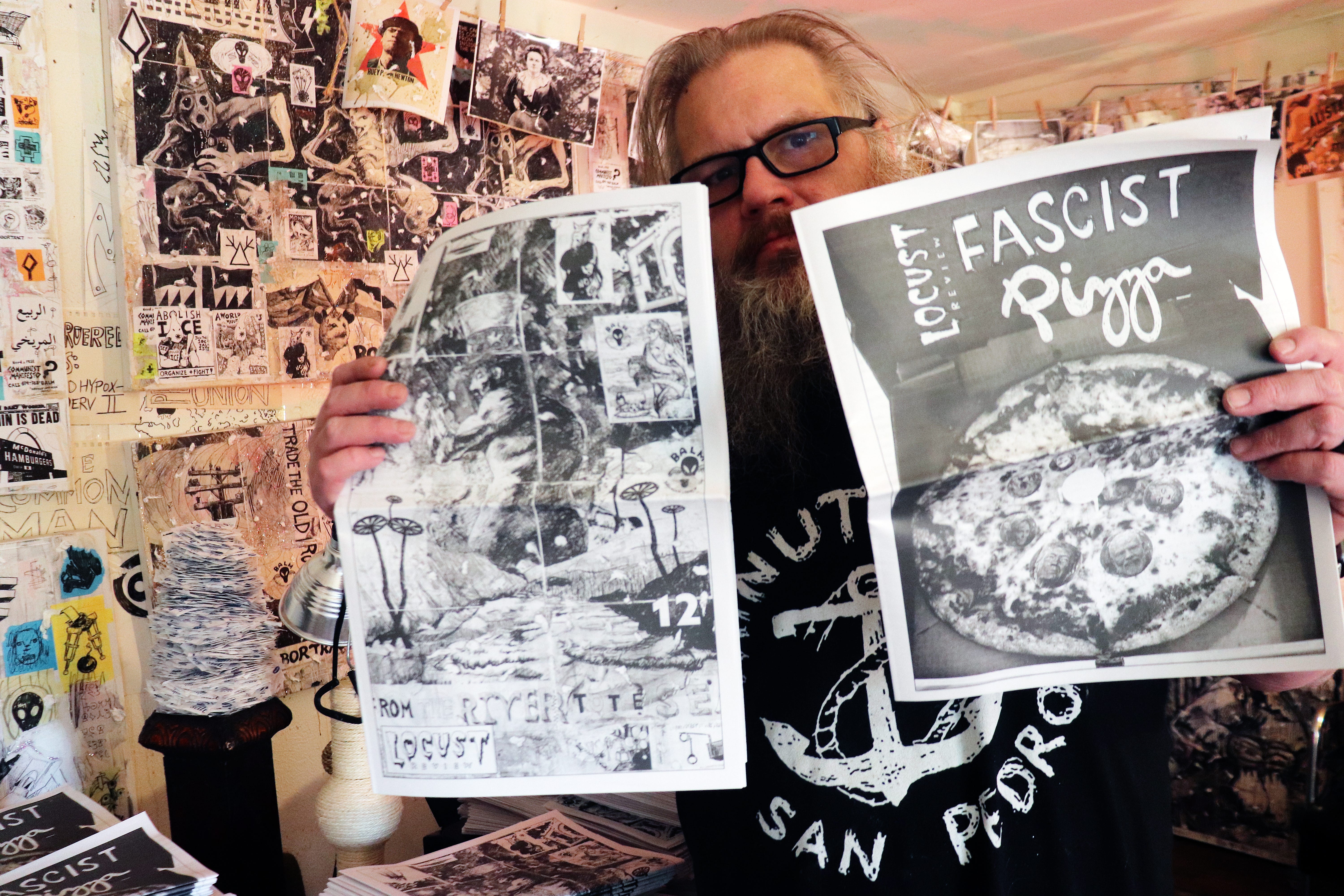
Locust publishes a mix of non-fiction and fiction, theory and actual artworks with a focus on the collective and individual subjectivity of working-class people. We’ve been publishing a serialized novella by my partner, Tish Turl, called Sound, about a janitor working in a “vice-house” in a dystopian future. We’re publishing the My Body series by the author R. Faze, in which an unreliable narrator discusses his own body in the third person as it engages in sabotage and goes through its workday. We printed an irrealist anti-capitalist role playing game. We conducted irrealist surveys where we asked readers to describe the taste of policemen to aliens. We publish the drawings and agit-prop of the Indian artist and communist Anupam Roy, the glitch art of the Chicago-based artist Omnia Sol, the mixed-media collages and assemblages I work on with my partner Tish. Among other things.
What inspired you to set up the The Born Again Labor Museum?
One of the things I note in Gothic Capitalism: Art Evicted from Heaven and Earth, is that everything that contextually surrounds an artwork becomes part of the meaning of the artwork. In other words, the exhibition and distribution of art is part of the performance of the art’s meaning. This is based on Walter Benjamin discussing the cultic performance of pre-capitalist artwork in the church. The processions, liturgies, and pilgrimages around a religious icon, an altarpiece, a sculpture of Moses, imbue those works with social and spiritual meaning. But this is true of modern and contemporary art as well. Part of the meaning of Pablo Picasso’s Guernica as anti-war and antifascist imagery is projected onto that painting because it was toured to raise money for the Spanish Republic, and because reproductions of that image were used in countless protests.
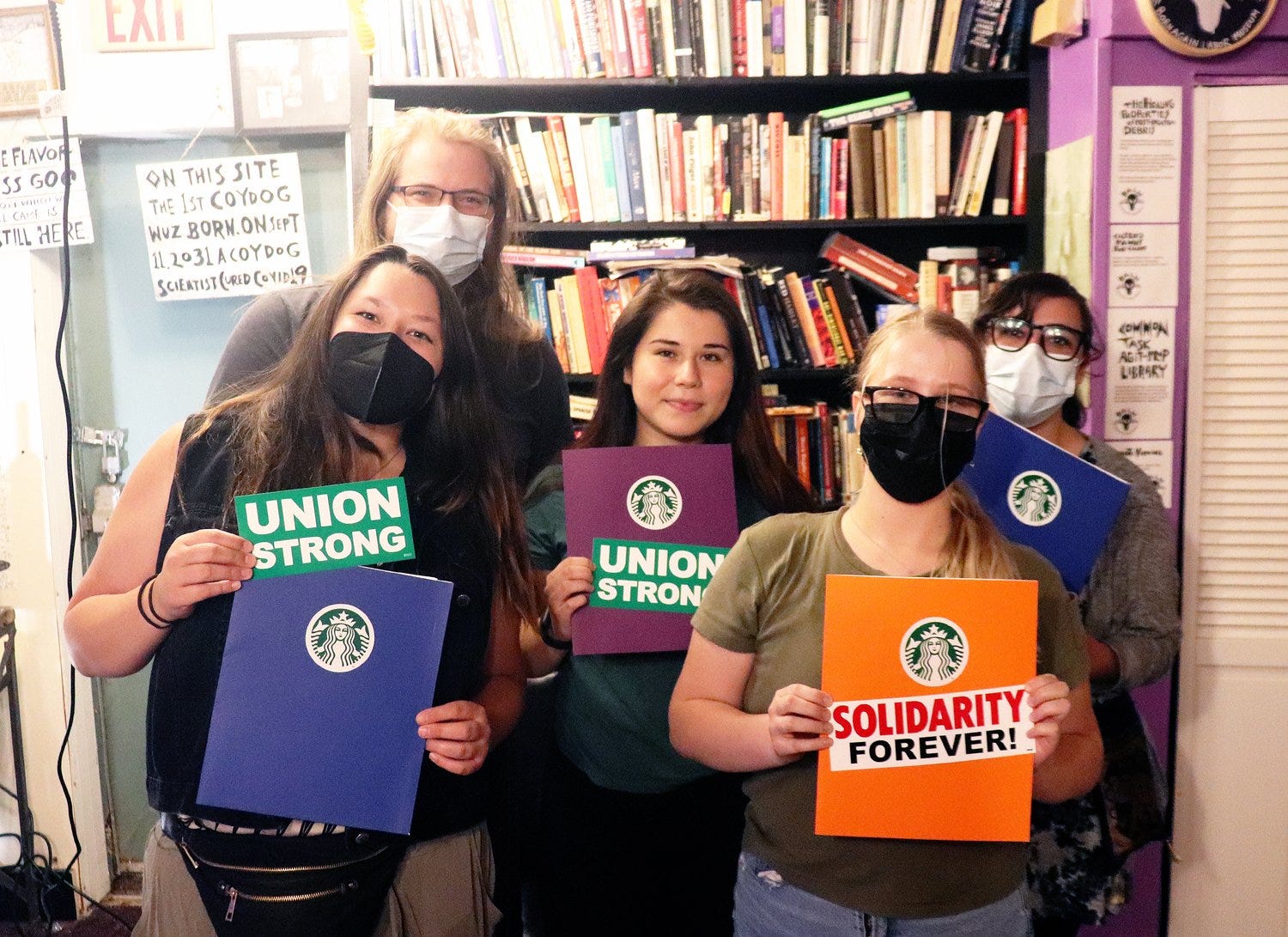
My partner and I were living in Las Vegas when we decided to start The Born Again Labor Museum (BALM) in 2018 and 2019. I was speaking on a panel on gentrification and art in Los Angeles in the wake of protests against art galleries in the working-class neighborhood of Boyle Heights. The galleries were seen, rightly, as tools of gentrification and displacement. It became clear to us that, even if the artists involved made consciously anti-capitalist artwork, the gentrification of Boyle Heights was feeding back into the works exhibited. We wanted to create art and an artspace that was conscious of its social performance as part of its meaning. So we moved back to southern Illinois and opened up BALM, using it as both an art space as well as an organizing space for labor unions and other social movements. We took a lot of inspiration from so-called “outsider” artists.
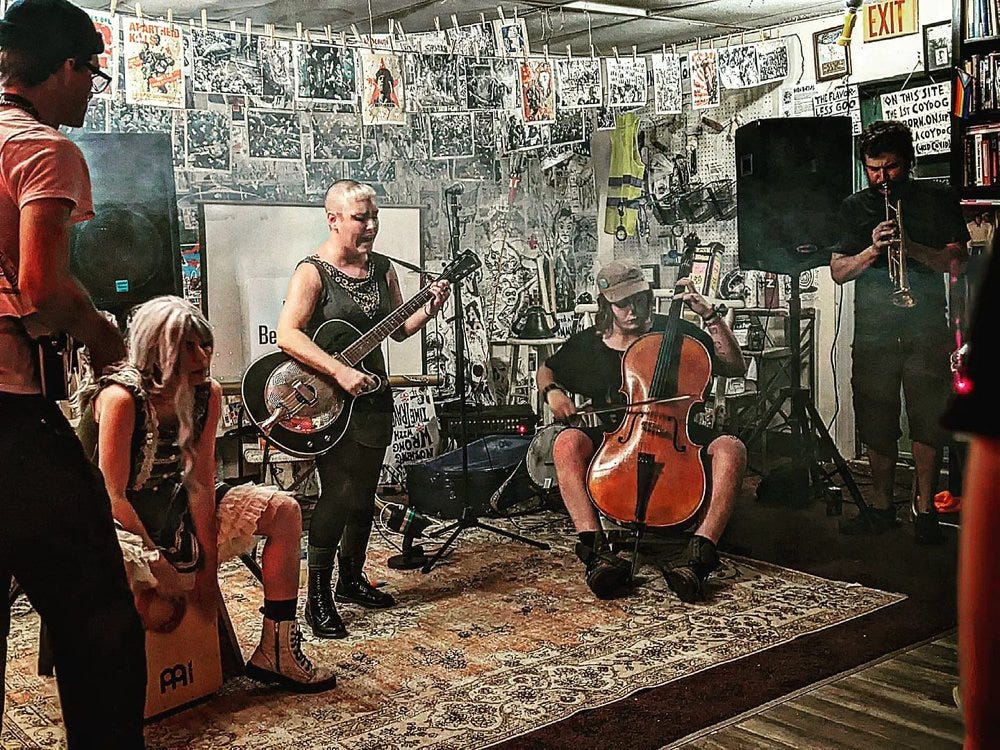
The name of the project, Born Again Labor Museum, involves an intentional conflation of evangelical language, “born again,” with Marxist terms like “dead labor” — meaning the capital exploited from previous generations of workers — and “living labor” — meaning the current generation of workers. The name is a kind of symbolic reclamation of what has been stolen from working-class people. And the artworks, involving collage and salvage, as well as interventions into the town, are meant to reflect that kind of reclamation as well, a reclamation of past and future.
What is 'Gothic Capitalism'?
It is ruins lit up by drone weapon fire and digital screens. It is a past that is both horror and nostalgia and a future that is both promise and threat. It is the working-class cybernetically fused with its exploited and oppressed ancestors (as dead labor) in the form of technology; technology that could be liberating, but is controlled by oligarchs like Elon Musk.
In classical Marxism, it was understood that capitalism was horrific, but developmentally necessary in that it created the material abundance that made a democratic socialist society possible. We are well over a century beyond the point where we could have created that egalitarian post-capitalist society. That exploited wealth, that could have been the basis of socialism, now threatens the viability of human life on Earth, particularly through climate change. Instead of development, in the Global North, we have industries that profit from its reversal, from the dissolution of civilization, as Naomi Klein and Richard Seymour describe in The Shock Doctrine and Disaster Nationalism, respectively. In this way, capitalism, outliving its historic usefulness, is itself gothic. It's consuming the progressive aspects of history and recapitulating its barbarisms.
What is presented as novelty and innovation in capitalist ideology turns cultural forms, institutions, and individual human beings into anachronisms, into ghosts from the past. This is experienced by working-class persons as a confusion of past and future. Contrast this to liberal and vulgar Marxist notions that there is a deterministic teleology of progress. In truth, the past is both strong trade unions and lynch mobs. The past is both Civil Rights and the Vietnam War. The past is not automatically better or worse than the present. It is both. And so is the future. We cured the old diseases that plagued humanity and then capitalism let new plagues fester. We created technology that should make all information and knowledge free. Capitalism uses it to addict us to social media and online gambling.
As Mark Fisher noted, we mourn the loss of past belief in alternative and emancipatory futures. We are surrounded by the ruins of possible futures. We can only begin to bring the future back to life by acknowledging the loss that surrounds us.
The USA is in dire straits - if you could make one change on the left to oppose Trumpism, what would you change?
There are three things that are wound up together. We should be more generous with other leftists, less generous with liberals, and more focused on the day-to-day organizing in our workplaces and communities. The so-called “big questions” are important, but they only come to life if we are part of the class struggle, and the everyday fight against imperialism, racism, and heterosexism. The moment is too urgent for us to either follow a failed liberalism or be sectarian toward each other, perfecting our politics in hermeneutical isolation. Plus, the hermeneutics never produced perfect politics anyway. It produced distortions that denatured the seeds of Marxist politics, and demoralized generations of erstwhile revolutionaries.
If I'm a visual artist, what will I get out of reading your book?
First of all, hopefully, something like love and/or hate. The most instructive things I've found as an artist are profound affinity or hostility. Artworks, theory, stories, films that we love or despise -- that we aren’t simply indifferent to or find banal enjoyment in — help us figure out what we want to say, and how we want to say it. Secondly, that individual subjective expression and emancipatory politics don’t have to be opposed to one another. They can and should be mutually reinforcing. Thirdly, we should connect our art practices with the working-class communities and social movements around us. Most of us aren’t going to “make it” in the institutional art world as it is presently constituted. Let’s take our artwork to the working-class, to the constituencies that can overhaul existing social relations, including that of the rarefied artworld. Not for moral or ethical reasons alone, but because it will make our artwork better.
Anything else you'd like to say to Revol's followers?
You should buy and read the books from Revol Press. Books are a commodity fetish so you will get some satisfaction from buying them from the dominant capitalist idiom. But books are also a fetish in the pre-capitalist sense. They are magical objects; more than the sum of their parts. You can feel this when you see the installations and large assemblages made of books by the artist Buzz Spector. Also, the content of the books is important. We need to reckon our existential and phenomenological realities — how we experience the world as unique but social individuals — with our theory and practice. These books aim to do that.
